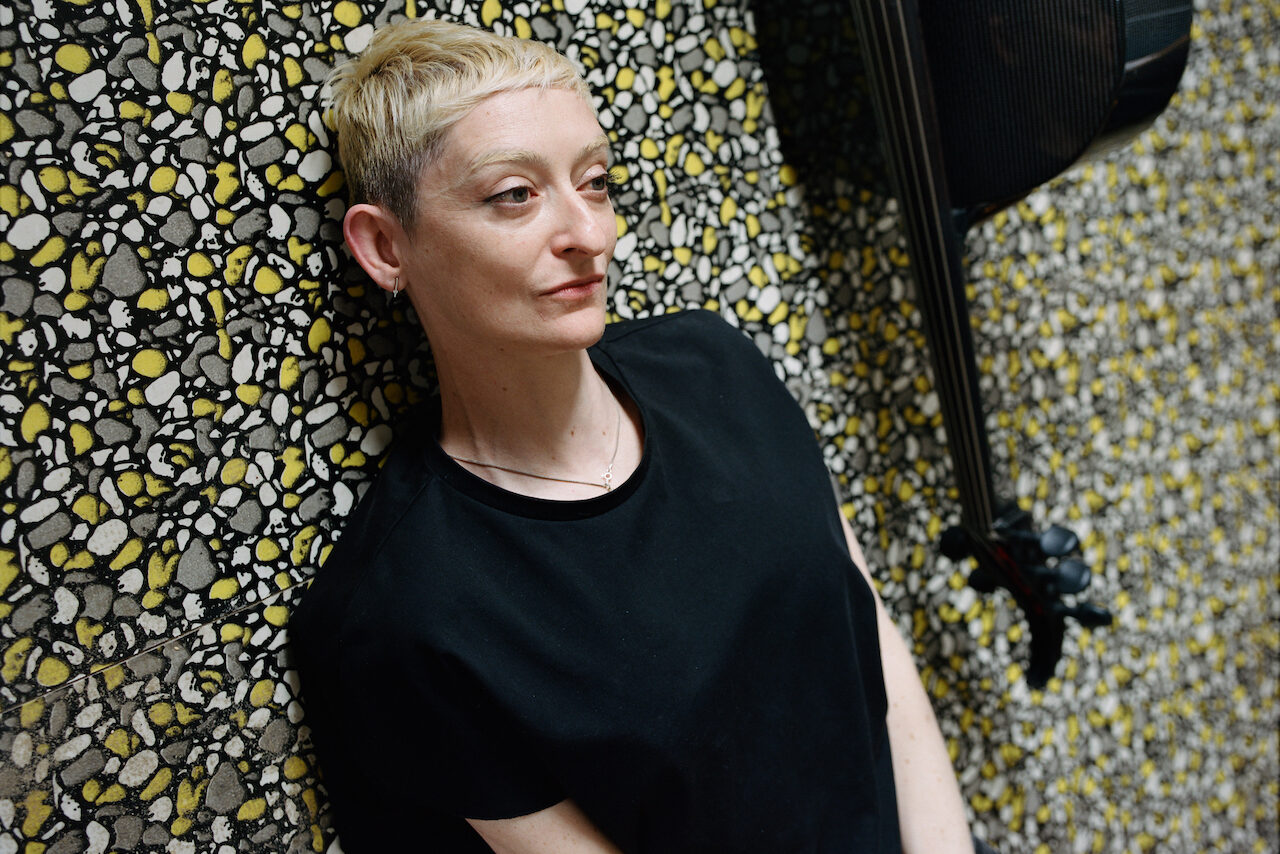
Cellist and composer Martina Bertoni started playing the cello at a very young age. Classically trained, her career further developed around experimental and film music, for which her cello has been featured in numerous records, works and soundtracks for films and series.
After two EPs and her debut full length All The Ghosts Are Gone (2020), Bertoni joined the Karl roster where she released Music For Empty Flats in January 2021 to critical acclaim.
On her new album Hypnagogia she continues to explore the sonic possibilities of her cello which she uses as primary source for composition and sound processing through reverbs, feedbacks and sub-bass frequencies, thus crafting sonic sculptures, rich of atmospheres and frictions, fed by ambient as much as drone and modern composition. Bertoni was one of the participating composer in our Satantango live project in March 2023.
FACTS
1. change is comforting
2. I am fascinated by Mathematics
3. I love cats and french pastry, Gilbert & George are probably my favourite artists
QUESTIONS
1. What is the biggest inspiration for your music?
The arithmetics and geometries in barock music
The resonances when I play cello
Imagining landscapes that actually do not exist
2. How and when did you get into making music?
I was 6 and I saw an orchestra of kids playing at my school, I had my eyes glued on the little cellists.
Right after, I came home and I tormented my parents until they bought me a cello. That was the start.
3. What are 5 of your favourite albums of all time?
It’s difficult to pick only 5, especially of all times…
William Basinski / The disintegration loops
Aphex Twin / Windowlicker (I know it’s an EP, but I don’t care!)
Nancy Sinatra + Lee Hazlewood / Nancy & Lee
Alva Noto + Ryuichi Sakamoto / any of
David Bowie / Blackstar
Special Mentions:
Fennesz / Endless Summer
Beatles / The White Album
Miles Davis / Miles in the Sky
4. What do you associate with Berlin?
A safe space, family, and the freedom to be what you want to be
5. What’s your favourite place in your town?
My home
6. If there was no music in the world, what would you do instead?
Difficult to figure, probably I would work in a cat shelter.
Or I would be a pastry chef.
7. What was the last record/music you bought?
Tezeta, by Hailu Mergia & The Walias Band
8. Who would you most like to collaborate with?
Arca!
9. What was your best gig (as performer or spectator)?
It was at Music Unlimited Festival in 1997, I was there to play a gig with David Shea, and in two days I got to see all my ‘avant-garde heroes’ of that time…Mick Harris, Thurston Moore, Zeena Parkins, Elliott Sharp. I was blown away and somehow I unconsciously decided that was definitely the music I wanted to play.
10. How important is technology to your creative process?
Technology for me is a liberation. I can explore countless possibilities and widen the complexity of what I can do. It’s a fun process and I love it. There’s so much to learn and use. And it’s very intriguing.
I am always very curious and interested in what happens next.
11. Do you have siblings and how do they feel about your career/art?
No siblings…I am an only child. My parents somehow always supported me even though they couldn’t really grasp the logic of what I was doing.